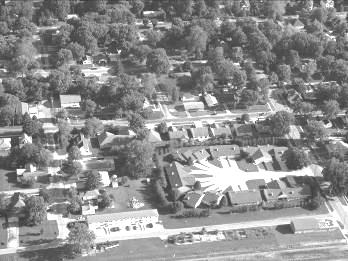
Former Tuscola Union School & South Ward Grade School Site
Former Tuscola Union School & South Ward Grade School Site
- Tuscola, IL, 61953
Excerpted from Tuscola Strolling Through the Past 1857-2007: A Pictorial History
The Tuscola Union School was built on the later site of the South Ward Grade School at the corner of Niles and Daggy Streets. Masons and Odd Fellows, with the usual ceremonies laid the cornerstone on June 26, 1870. The northeast cornerstone contained the organization of Coles County, the partition of Douglas County, 1859 survey of original town of Tuscola, 1857; accounts of the first dwelling, 1857; first store, 1857; and first, second and third bricks built, 1863, etc., first children born, 1857; burning of first hotel, and incidents; Illinois Central Railroad, schoolhouses; first church, 1862; flour mill, 1863; newspaper, 1858; first bank, 1863; first court house, 1861; the permanent court house and population of Tuscola, 1870, 1,500, with 300 dwellings. These by H. C. Niles, who was the first County Surveyor. Mr. R. B. Maclpherson placed in the stone a history of Odd Fellowship and Masonry. A history of the school district to date was inserted by Dr. J. L. Reat and W. B. Dryer; Niles also added the latitude and longitude, variation of the compass, exact location of Tuscola, the area of the county, the names of the first Village Board, via L.J. Wyeth, W. T. French, James Davis, F. F. Nesbit, M. V Vaul, Clerk; also date of charter, first election under charter July 1, 1859. J. H. Martin, Mayor; Council, W. Taggart, M. Pugh, E. Price and J. Williamson; the corporation expenses for preceding fiscal year were stated at $5,000; a description of former school houses; the average attendance of pupils was stated as 448, in 1869-70. Indebtedness of the school district was given as $20,000, for which the district had issued bonds due in three, five and seven years with 10 per cent interest, and that the bonds were sold for .92 cents. These with copies of current newspapers were placed in the corner stone, which, by the way was not half-full. It was well secured in the usual manner, and the ceremonies were smoothly and agreeably conducted under the care of Mr. William H. Lamb, the Worshipful Master of the Masonic Lodge, Tuscola, No. 332.
This was a three-story brick building costing $40,000. It was described as having “a belfry with a large town clock, a basement, steam heat, electric lights, ample fire escapes and flushing water closets.” The clock was considered a most excellent timekeeper, had four dials, facing respectively the cardinal points. It was of genuine bell metal – copper and tin – and weighing 800 pounds. The bell, when tolling or marking off the hours, had a peculiar resonant sweetness. September 19, 1882, at midnight, Tuscola bells tolled the announcement of the death of President Garfield, on which occasion the ringers of four bells exchanged sounds with each other in sequence, each waiting until an effect had died away. The varied tones, though differing in volume, were of perfect accord, which, with the otherwise silent night, and the hearers between sleeping and waking, were simply and sadly beautiful. The school bell had been heard to strike the hours at a distance of about seven miles, under favorable conditions.
It was at the time this building was erected that the present system of an eight-year grade school and a four-year high school was organized. The high school students occupied the entire third floor of the new, attractive building. Discipline and methods of instruction were very rigid. Boys and girls filed in at separate doors when school began. They had cloakrooms at opposite ends of the building and they played at opposite ends of the playground. All of the students studied in a common study hall, and when one bell rang, they turned their seats; at the sound of the second bell, they stood; and on the third bell, they passed quietly in lines down the hall to the classrooms for discussion and recitations. The first high school graduation class numbered four members who graduated in 1875. They were Lillian Daggy, Emma Wyeth, Tennyson Daggy and John C. Russell. By 1880, the number of graduates had reached fourteen, and from that time on the number wavered up and down, some times going back to four, then up to ten or twelve, until 1910 when the number was twenty-seven. The whole student body in 1887 was sixty-two. The teachers received from $35 to $40 a month and the janitor was paid $50 a month.
FIRE
On October 12, 1921, the Union School burned to the ground. The fire started in the belfry at about 1:00 P.M. By 1:30 P.M., the alarm had been sounded and the children were directed out of the building before it was suspected the fire was serious. Students walked downstairs as they had the day before during a fire drill, as it was “Fire Prevention Week.” Many parents, learning of the fire, hurried to the scene, to claim their youngsters. The cause of the fire was never determined. Harold Lincoln, who with Fred Burmeister, was the last to leave the building alive, performed a heroic act in returning to the structure to recover Alliece Warren’s watch and purse. They with Roy Bird, a letter carrier who was delivering mail in the building, assisted in getting some of the children’s wraps. The first two escaped but it was believed Mr. Bird was caught in the collapse of the ceiling. His remains were later recovered from the ruins. The loss of the building left the schoolchildren without a home. All of the furnishings and books were lost. Every student had to purchase new books, which was quite an expense, in order to continue their studies. However, immediate arrangements were made to put the high school students in the Courthouse and the grade school children in the Chamber of Commerce, the First Christian Church,
the Presbyterian Church and the Methodist Church.
THE DAY THE SCHOOL BURNED.

BY LOIS MARSH
TCHS CLASS OF 1929
It was a beautiful, warm Fall Day on October 12, 1921. It was also Fire Prevention Week. We had had Fire Drills on how to get out of the School House in event of a fire.
The old building was square with the first four grades on the ground floor, the fifth, sixth, seventh and eighth grades on the second floor and the high school on the third floor. After lunch every day, the High School Chemistry students went to the basement to class. I was in the fifth grade on the second floor at that time. We heard the high school class going down stairs, but that happened every day. We were having Spelling class when our door opened and Effie Fry English said, “School house is on fire.” So, we marched out as rehearsed. Our class was the last one out.
Later we learned that Mrs. Hackett who lived across the street from the school was the first to see the fire, which started in the belfry. The windows of the school were open and they heard her say, “School House is on fire.” It seems some boys were smoking in the belfry over the lunch hour.
There was only one life lost. It was Roy Bird. He went in the building to get his daughter’s books and the bell fell on him.
SOUTH WARD GRADE SCHOOL
Construction of the South Ward Grade School began after the fire in 1921 that destroyed the Union School. While the high school was being constructed at Niles and Sale Streets, the grade school was underway at Daggy, Niles and S. Central Streets. This building educated the students south of the railroad tracks in grades one through eight. Later children grades one through six on the south side of the tracks attended South Ward Grade School. The students were moved to North Ward Grade School at the start of their seventh grade year. Before construction began, a prosperous farmer donated a brass bell and striking clock to the new school requesting that his name not be revealed until after his death. The bell rang in the memory of William Brian (the grandfather of Mrs. Mary Ross). Mr. Brian died shortly following his donation. He did not live to see the school or bell in place. The bell was tolled during his funeral procession.
At the end of the 1975-76 school year, its doors were closed for the last time. The building was sold at an auction to Bill Huber and Kenny Ring in 1977. The school was razed in 1980. The cornerstone was removed and held many mementos of the city’s history: a Tuscola Review; a Tuscola Journal; letters from the city banks, businesses and organizations; an 1831 coin; an 1863 penny and a 1921 silver dollar. Harold Weber rang the old bell with a hammer 59 times, one time for each year of the school’s existence. Bricks from the South Ward School were used to support the school’s bell at a new location in front of the East Prairie School in 1983. The bell was relocated again in the summer of 2001 to the new North Ward School on North Prairie Street.
South Ward Square
On this site in the 1990s, a small residential cul-de-sac was developed and named in honor of the school.